
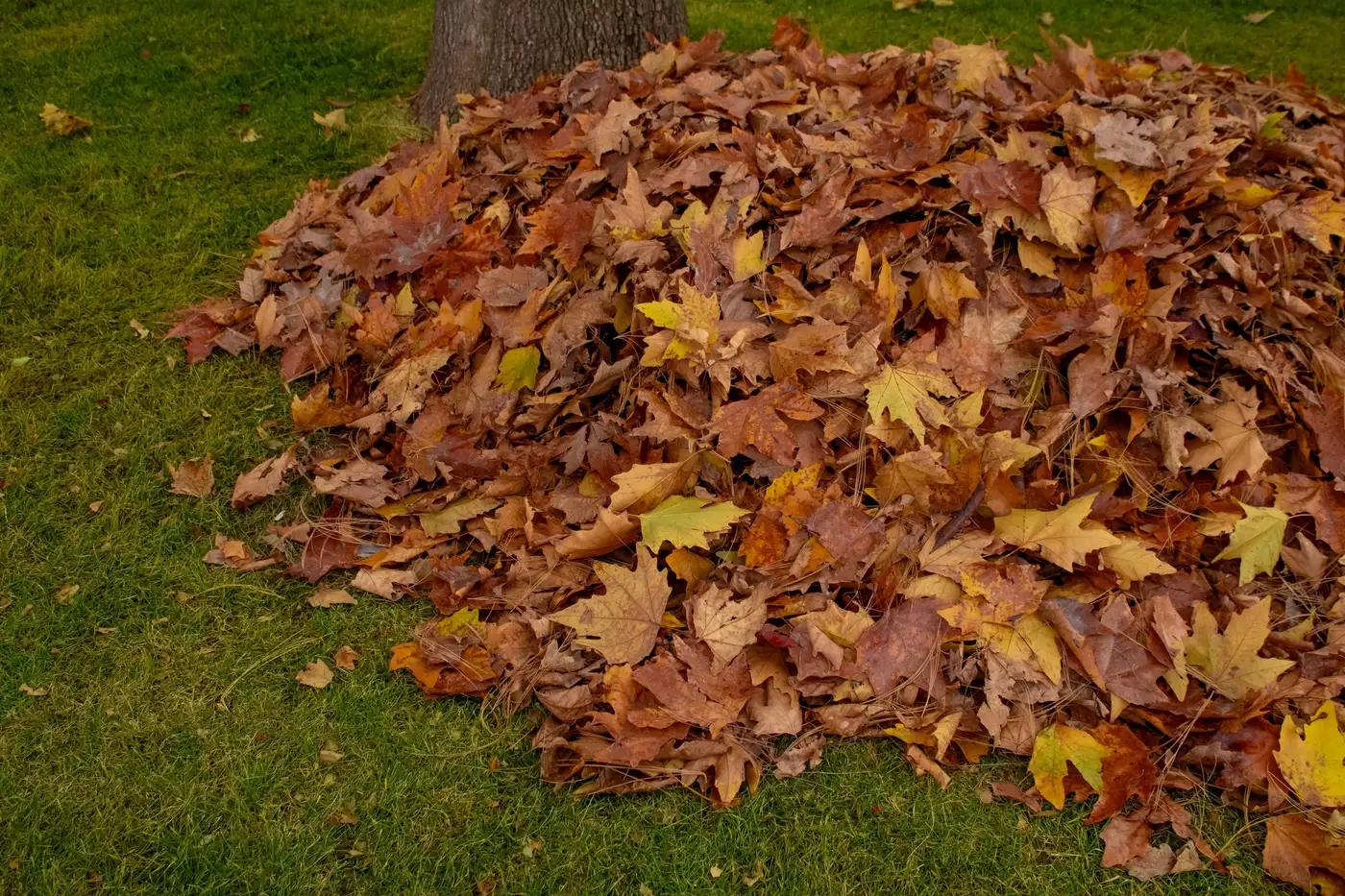
Every fall, the same question arrives from homeowners across Worcester County and MetroWest: when should the leaves come off? The honest answer is that it depends less on the calendar than on what is growing over your particular property — and that on most Massachusetts lots, one visit is not going to do it.
Here is how the drop actually runs in this part of New England, and how to plan around it.
Different trees, different calendars
Leaf drop is not a single event. On a typical Central Massachusetts property, it plays out over six to eight weeks, tree by tree.
- Ash and birch tend to go first, often before the end of September.
- Maples — the trees that give the region its color — usually drop hardest through October, and go fast once they start.
- Oaks are the problem. Red and white oaks hold their leaves well into November, and some hang on to brown foliage all winter.
- Pines shed needles in a quieter, steadier way, and those needles mat into beds rather than blowing clear.
Why one pass is usually the wrong plan
If a property is maple-heavy, a single cleanup in late October can genuinely be enough. If there is a mature oak canopy — which is most of Worcester, Shrewsbury, Natick and the Boston suburbs — a late-October cleanup will look excellent for about ten days and then need doing again.
The practical approach on a mixed canopy is two or three visits: an interim pass while the maples are dropping so the turf is never buried, then a final pass after the oaks let go, usually after the first hard freeze. The final visit is the one that matters most, because whatever is on the lawn when the snow arrives is what stays there until spring.
What happens if leaves stay on the lawn
A wet leaf layer mats down and blocks light from the turf underneath. Under snow it goes anaerobic, and that is where the gray and pink snow-mold patches that homeowners find in April come from — the ones that look like winter kill but are really a cleanup problem from the previous November.
Leaf packs also cause trouble away from the turf: at catch basins and downspouts, where they hold water that then freezes; and in beds, where a thick mat holds moisture against the crowns of perennials and the base of shrubs all winter.
What a proper fall cleanup includes
Cleanup is more than blowing the lawn. A full fall visit clears turf areas, empties the planting beds, pulls leaves away from foundations, walks and drives, cuts back the perennials that should be cut back, and hauls the debris off the property rather than blowing it into the tree line.
It is also the moment to look ahead. The last cleanup and the first plowable storm are often only two or three weeks apart, so it is the natural time to have the property walked and staked for a snow contract.
So when should you book?
Book in September or early October. Not because the work happens then, but because the schedule is built then — and a property that is on the route can be timed to its own canopy instead of squeezed into whatever slot is left in mid-November.